
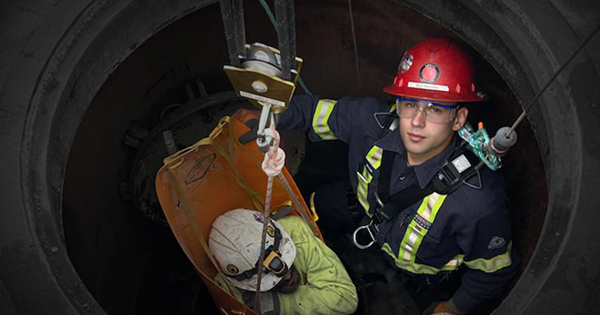
In the industrial agriculture industry, confined space rescue is often viewed as the response to an emergency. But by the time a worker becomes trapped, engulfed, injured, or unresponsive, the conditions for a successful rescue have already been shaped by decisions made before entry.
That is why rescue planning should not be treated as a separate emergency procedure. It should be part of the entry decision itself.
Grain bins, silos, pits, tunnels, tanks, and other confined spaces can expose workers to flowing or bridged grain, operating equipment, oxygen deficiency, toxic atmospheres, combustible dust, falls, and structural hazards. In an emergency that develops so quickly, there may be no time to begin figuring out how a rescue will work.
A Plan Must Fit the Space
A generic rescue plan may satisfy a requirement on paper, but it may offer little protection if it does not reflect the space being entered.
Before authorizing entry, the team should consider how an incapacitated worker could be removed from that specific location. Is the opening large enough for the entrant, rescue equipment, and rescuers? Does the space require vertical or horizontal retrieval? Are there internal ladders, conveyors, augers, braces, or other obstructions that could complicate removal? Is the planned retrieval system appropriate for the space and positioned where it can be used effectively?
The hazards and necessary equipment can vary significantly from one confined space to another. Respiratory protection, protective clothing, harnesses, retrieval lines, and other equipment must be selected for the conditions and properly inspected before use. Equipment that is available but unsuitable for the space does not create rescue readiness.
A meaningful rescue plan must be specific to the worksite and the entry being performed.
Rescue Feasibility Is a Go/No-Go Question
Before entry begins, the team should be able to answer several practical questions:
What emergency conditions could reasonably occur during this task?
How would the entrant be reached and removed?
Can the preferred rescue method be performed without sending another worker into danger?
Is all necessary rescue and retrieval equipment present, inspected, and ready?
Can the entrant and attendant communicate throughout the work?
Does the attendant know when to order an evacuation and whom to contact?
If outside responders are part of the plan, are they familiar with the facility, its confined spaces, access points, and hazards?
Is the expected response time appropriate for the hazards involved?
If these questions cannot be answered clearly, the entry may not be ready to proceed.
This is especially important when a facility intends to rely on a local fire department or another outside response organization. Outside rescuers may need familiarity with the facility’s spaces, hazards, entry points, rescue equipment, and required PPE. Listing an emergency phone number is not the same as confirming that an effective rescue can be performed.
When Response Time Determines the Outcome
Calling 911 is an important step, but it is not a complete rescue plan. Some confined space emergencies develop so quickly that, by the time an outside team is contacted, travels to the facility, assesses the scene, and prepares to enter, the window for a successful rescue may be closing, or may already have closed.
This does not mean untrained employees should attempt an entry rescue. Doing so can create additional victims; OSHA estimates that 60% of confined space fatalities involve would-be rescuers. Instead, it underscores the need to evaluate response capabilities before work begins. If a facility relies on a fire department or another outside organization, leaders should know whether that team is trained and equipped for the facility’s spaces, understands the site’s hazards and access points, and can respond within a timeframe appropriate for the hazards involved.
For some entries, the difference between rescue and recovery may be measured in minutes. That makes response time, on-site retrieval capability, and a clearly understood emergency plan essential parts of the go/no-go decision.
Prioritize Non-Entry Rescue Where Possible
In many situations, the safest rescue is one that does not require another person to enter the space. Non-entry rescue can use equipment such as a rope or winch to retrieve a worker without exposing a rescuer to the same hazards.
However, non-entry rescue must be planned rather than assumed. The retrieval system must be compatible with the space, the entrant must be connected appropriately, and the path of removal must remain clear. A line or harness alone will not solve problems created by grain pressure, internal obstructions, unsuitable anchor points, or an opening through which the worker cannot be removed.
The objective is not merely to have retrieval equipment nearby. It is to know how that equipment would function under realistic conditions.
Prevent the Second Emergency
When a coworker is in danger, the natural reaction is to help immediately. In a grain bin or another confined space, however, an impulsive rescue attempt can expose additional workers to flowing grain, hazardous atmospheres, or unisolated equipment.
Everyone involved in the entry should understand that the attendant’s responsibilities do not include entering the space to perform an improvised rescue. The response should follow the established plan, including stopping operations, summoning the designated rescue resource, and beginning non-entry retrieval when it is safe and appropriate to do so.
That discipline requires more than written instructions. Teams need opportunities to review their roles, walk through procedures, inspect equipment, and practice emergency response before those skills are needed. A drill can reveal problems that paperwork may not: a retrieval line that binds, an anchor point that cannot be reached, unreliable communication, or confusion about who has authority to act.
Plan for Rescue Before Every Entry
Confined space safety is not measured solely by whether a facility has a rescue plan. It is measured by whether that plan can work in the actual space, with the available people and equipment, under the conditions present that day.
Before anyone enters a grain bin, silo, pit, or other confined space, leaders should ask one direct question:
If this worker cannot exit on their own, are we truly prepared to get them out safely?
If the answer is uncertain, entry should wait. Rescue does not begin when the emergency occurs. It begins with the decisions made before the first worker crosses the opening.
Source:
Rolly Walker, General Manager at Arnco Safety - rwalker@arncosafety.com