
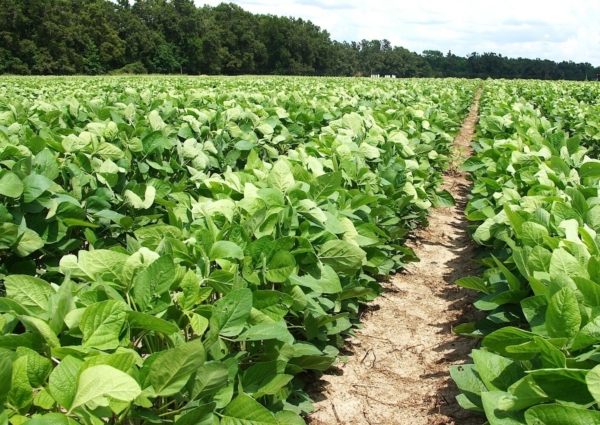
Red crown rot, a fungal disease of soybean, is spreading across Illinois and other Midwestern states, prompting researchers to investigate management strategies and develop tools to help growers make informed treatment decisions.
First confirmed in Illinois in 2018, the disease has since spread to 51 counties across the state and has been detected in Indiana, Iowa, Kentucky, Missouri, Nebraska, Ohio and Wisconsin.
Boris Camiletti, a plant pathologist and assistant professor at the University of Illinois Urbana-Champaign, is leading research efforts alongside the Crop Protection Network, the Illinois Soybean Association, the United Soybean Board and researchers in surrounding states.
Understanding Red Crown Rot
Red crown rot is caused by the soilborne fungus Calonectria ilicicola, formerly known as Cylindrocladium parasiticum. The fungus attacks soybean roots and can spread through the movement of contaminated soil, including soil attached to farm machinery.
The disease begins when hardened fungal structures called microsclerotia germinate and produce threadlike hyphae. These structures penetrate root cells and move into the plant, producing toxins that eventually kill plant tissue.
Microsclerotia can survive in soil for several years. Nearby roots can stimulate them to germinate, while warm, wet conditions favor infection of young soybean roots.
Recognizing Disease Symptoms
Red crown rot symptoms often first appear at the root crown, just below the soil surface where the roots meet the stem. The crown and lower stem may develop a reddish discoloration, along with fungal structures such as white patches or tiny, brick-red spore-producing spheres called perithecia.
Infected plants may show reddish stems during early vegetative growth, as soon as the V2 stage. Foliar symptoms often do not appear until the reproductive stages, typically between R3 and R5. Yellowing between leaf veins, known as chlorosis, can progress to necrosis and leaf death.
Severe infestations can reduce yields by 60% to 70%, although the overall impact depends on the extent of infection within a field.
Identifying the disease can be difficult because its foliar symptoms closely resemble those of sudden death syndrome, brown stem rot and damage caused by some fungicides, including triazoles. Symptoms also can resemble those of Neocosmospora stem rot, which was first reported in Illinois in October 2026.
Because characteristic fungal structures may not appear until late in the growing season, researchers recommend testing suspicious plants rather than relying on foliar symptoms alone. Growers can submit samples to the Illinois Extension Plant Clinic for diagnosis.
Tracking the Disease Across the Midwest
Red crown rot also can be difficult to track across the region. Although disease maps document its presence in multiple states, researchers suspect it is more widespread than current observations indicate. Gaps in reported cases may reflect insufficient scouting and testing rather than the absence of the disease.
Within individual farms, disease incidence can vary substantially between fields and even within the same field. Yield losses in affected patches can reach 60% to 70%, but total field losses depend on how much of the field is infected.
Management Practices and Seed Selection
Although no reliable method completely controls red crown rot, several practices may help reduce its spread. Growers should avoid moving infected soil within and between fields, sanitize equipment between fields and plant fields known to be infected last.
Crop rotation is less likely to provide effective control because the fungus can survive in soil for several years. Continuous corn for multiple years may not eliminate the disease and can introduce other production challenges.
Some seed treatments are labeled to suppress red crown rot during the first few weeks after planting. The Crop Protection Network's 2026 guide to fungicide efficacy for soybean seedling diseases provides information relevant to the North-Central region.
Soybean variety selection also may influence disease outcomes. Researchers have observed considerable variation in resistance among varieties, as well as interactions between seed treatments and specific varieties. Growers should consult seed dealers about available disease ratings and varieties that may be more susceptible.
Research Aims to Improve Treatment Decisions
Camiletti and his research partners are evaluating soybean varieties and seed treatments to improve recommendations for growers. They also are developing a project to help farmers determine whether investments in treatments for red crown rot and other fungal soybean diseases are economically justified.
Supported by the Illinois ACES Land-Grant Initiative, the project will combine satellite imagery, field data and machine learning to develop a decision-support system that helps producers target disease management investments more effectively.
Through the Crop Protection Network, the research team plans to deliver two tools. A Disease-Area Estimator will map the portions of fields affected by disease, while an ROI Calculator will help growers evaluate treatment decisions based on disease extent, risk, input costs, crop prices and expected returns.
The tools are intended to address a challenge facing growers: The patchy distribution of soybean diseases can make it difficult to estimate how much of a field is affected and determine whether higher-cost seed treatments and other inputs are likely to pay off.
The Illinois ACES Land-Grant Initiative is a competitive grant program supporting projects co-led by researchers and Extension staff. The program emphasizes interdisciplinary research and practical solutions, with Extension personnel helping guide research and put findings into practice across Illinois.
Source: University of Illinois Urbana-Champaign, "What is red crown rot? Illinois expert explains emerging soybean pathogen"