
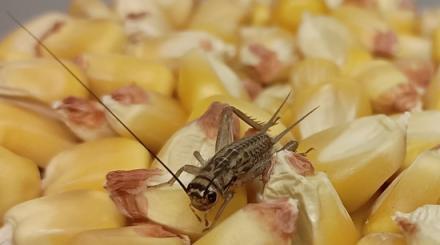
Photo credit: U.S. Department of Agriculture Agricultural Research Service.
Agricultural Research Service (ARS) researchers in Peoria, Illinois, and Stoneville, Mississippi, are exploring a way to recover value from mycotoxin-contaminated corn by using crickets to convert the grain into a high-protein feed ingredient.
Corn is a staple of livestock feed across the United States because it is affordable and provides essential fiber, vitamins and minerals. However, fungal mycotoxins at levels exceeding U.S. Food and Drug Administration regulatory limits can pose serious health risks to animals, making contaminated grain unsuitable for feed.
To protect livestock, mycotoxin-contaminated corn is often diverted from the feed supply chain. Although this practice is an important safety measure, it can result in financial losses for farmers and grain processors and contribute to agricultural waste.
ARS researchers investigated whether crickets could safely consume contaminated corn and be processed into insect meal for use as a feed ingredient. The research found that insect meal produced from crickets raised on contaminated corn contained nearly three times the protein of corn while reducing mycotoxin levels in the resulting meal by 96%.
The approach could provide a way to recover value from corn that would otherwise be discarded or significantly devalued. By converting contaminated grain into a higher-protein coproduct, insect rearing could offer farmers and processors an alternative use for grain that cannot safely enter conventional livestock feed channels.
The research highlights the potential for insect-based production to reduce agricultural waste while creating additional value from contaminated grain, provided the resulting feed ingredient meets applicable safety requirements.
Source: U.S. Department of Agriculture Agricultural Research Service, "Safe Feed, Less Waste: Crickets Clean Up Contaminated Corn"