

In a grain elevator or feed mill, a process can look simple until several people are asked to describe it. The scale operator may explain truck receiving one way, the probe operator another, and the dryer operator, quality manager and superintendent each may see a different starting point or priority. None of them are necessarily wrong. They are describing the portion of the work they know best.
Over time, busy facilities develop workarounds, informal decision rules and “the way we have always done it.” Experienced employees keep the operation moving through judgment and memory. But when harvest pressure builds, a key employee is absent, a new operator starts or conditions change quickly, those unwritten processes can create delays, errors, rework, safety exposure and customer frustration.
Business process management, or BPM, is a practical way to address that problem. It helps a facility understand how work actually gets done, establish the best-known method, measure results and continually improve the process.
What Is BPM?
A business process is a connected set of activities that produces a result for a customer, another department or the business. In grain and feed operations, it might be receiving grain, operating a dryer, producing a feed batch, loading railcars, changing commodities, processing a maintenance request or managing a fumigation program.
The process is more than physical product movement. It includes people, equipment, information, decisions, quality checks, safety controls, tickets, communications and handoffs between departments. A truck-receiving process, for example, includes check-in, sampling, grading, routing, weighing, unloading, ticket completion and the information that connects every step.
BPM is not a software purchase or another binder of procedures. It is a disciplined way to make daily work clearer, more repeatable, safer and easier to improve. It does not ask people to work faster or take shortcuts. It asks the process to work better by reducing waiting, confusion, duplicate effort, inconsistent decisions and recurring mistakes.
BPM is sometimes confused with process mapping, Lean, Six Sigma, workflow management or software automation. Those are all useful tools, but they serve different purposes: Mapping shows how work flows, Lean helps remove waste, Six Sigma reduces variation and automation can speed up routine tasks. BPM is the ongoing discipline that brings those elements together to ensure the entire process is understood, owned, standardized, measured and improved over time.
Why It Matters
Grain and feed facilities operate where small process failures can have large consequences. Harvest compresses huge volume into short windows. Feed mills must protect formula accuracy, ingredient integrity and delivery schedules. At the same time, operations depend on constant handoffs: from the probe to the scale, from quality control to operations, from maintenance to production and from merchandising to loadout.
When either product flow or information flow breaks down, the operation loses time and often money. BPM can reduce seasonal truck delays, inconsistent grading or dryer decisions, ticket corrections, repeat work, quality variation, unclear responsibilities and the safety risk that comes when people feel forced to rush. It also captures valuable operating knowledge so that it can be taught consistently rather than residing only in the memories of experienced employees.
The BPM Cycle
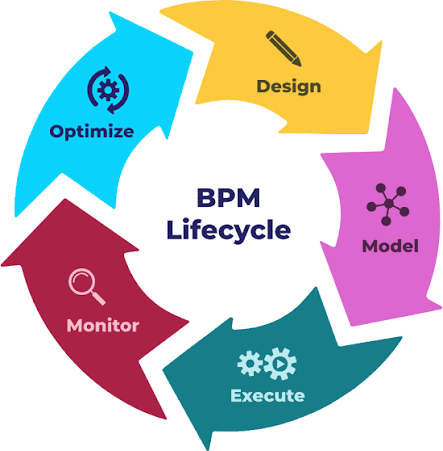
BPM works best as a simple, repeatable cycle.
- Observe the current process. Watch the work as it is actually performed, not just as an SOP says it should be performed. Talk with operators, scale personnel, maintenance, quality, office staff and supervisors. Look for delays, workarounds, repeated questions and differences between shifts.
- Map the flow. Put the major steps on paper or a whiteboard. Show where grain, feed and information move; who owns each step; where decisions are made; and where work is repeated. The goal is not a complicated diagram. It is a shared picture of the work.
- Standardize the best-known method. Clarify roles, decision rules, quality checks, safety controls and communication expectations. The standard should be practical enough to use on a busy shift, not a document that only works in the office.
- Measure what matters. Choose a few useful indicators: truck turn time, tons per hour, dryer performance, downtime, ticket corrections, rework, quality variation or safety near misses. The purpose is not to collect data for its own sake. It is to identify where the process needs attention.
- Improve and repeat. Review results with the team, correct recurring issues, update the standard and repeat the cycle. A process map has little value unless the improved method becomes part of everyday work.
A Harvest Truck-Flow Example
Consider a facility where truck lines build during harvest. The first assumption is often that the receiving pit lacks capacity. Sometimes that is true. But the pit may simply be the most visible point in a larger process problem.
A BPM review follows the full flow: arrival, check-in, sampling, grading, contract verification, moisture routing, bin or dryer assignment, scale movement, unloading, ticket completion and exit. The team may find that the real delay occurs before the truck reaches the pit. Grading results may be slow. The scale operator may not have current bin or dryer status. Different shifts may route similar grain differently. Ticket information may be entered twice, leading to corrections after unloading.
Once the full process is visible, the team can address the actual constraint. It may standardize routing decisions, improve communication between the scale and control room, make bin and dryer status visible or establish a more consistent shift-handoff routine. Tracking truck arrival-to-exit time and the reasons for unusual delays shows whether the changes are working.
“BPM helps a facility fix the real constraint — not merely the most visible one.”
Getting Started
A facility does not need a new software platform or a six-month project to begin. Choose one process with a visible impact on safety, quality, throughput, customer service or cost. Bring together the people who perform and support the work. Map the current state honestly, including the workarounds and exceptions. Identify one or two high-impact improvements, establish a practical standard and measure the result.
BPM works well alongside other continuous improvement tools. Process mapping makes the workflow visible. Root-cause analysis helps explain recurring problems. OEE highlights equipment losses, and SMED reduces changeover time. BPM gives teams a practical way to incorporate those improvements into a consistent daily process.
The common objections are familiar: “We are too busy,” “We already have SOPs” or “Every situation is different.” Yet the time spent waiting, correcting mistakes, answering repeated questions and managing daily fire drills is often greater than the time needed to improve one important process.
Business process management is not about creating more paperwork. It is about making work visible, repeatable and easier to improve. In grain and feed operations, where every handoff, decision and minute of delay matters, that clarity can become a real competitive advantage.