
Purdue University’s 2025 data show fewer grain entrapments and a lower fatality rate, but persistent risks, reporting gaps and costly consequences leave little room for complacency.
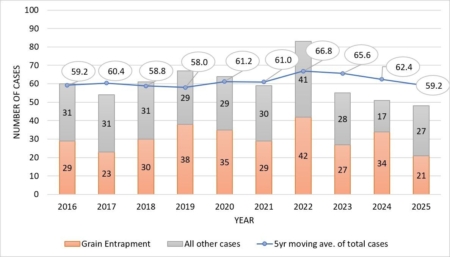
The latest national count of agricultural confined space incidents offers a measure of progress, but not permission to relax. Purdue University researchers documented no fewer than 48 cases in 2025, including 22 fatalities and 26 nonfatal cases. That was a 5.9% decline from the 51 cases recorded in 2024 and well below the five- and 10-year averages of about 60 cases annually.
The improvement was most pronounced in grain entrapments. Purdue documented 21 cases in 2025, down about 38% from approximately 34 in 2024. Six of the 2025 entrapment cases were fatal, producing a fatality rate of 28.6%, compared with 41.2% the previous year.
Those numbers matter to grain handlers, but they need context. Annual totals can move sharply, and one lower year does not establish a lasting trend. Purdue’s 10-year record shows that grain-entrapment frequency has remained relatively stable despite year-to-year swings. The broader total also includes cases that never become part of an official reporting system.
The 2025 findings are best read as a snapshot of where prevention may be working, where exposure remains concentrated and where the industry still lacks a complete view of the problem.
A Broader Picture of Risk
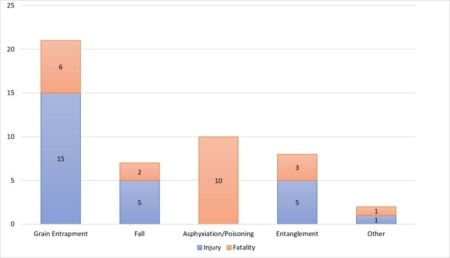
Grain entrapment remained the largest category in 2025, accounting for 21 of the 48 documented cases. The remainder included 10 asphyxiation or poisoning cases, eight equipment entanglements, seven falls into or from grain storage structures and two cases involving other circumstances.
The categories reinforce a point that can be lost when confined-space safety is discussed only in terms of engulfment. Work around bins, silos and related equipment can expose employees to falls, moving machinery, oxygen-deficient or toxic atmospheres and other hazards. A facility’s incident-prevention efforts must account for the full task and work area, not only the possibility of a worker becoming trapped in grain.
The consequences also vary by incident type. All 10 asphyxiation or poisoning cases recorded in 2025 were fatal. Grain entrapments, by comparison, resulted in six fatalities and 15 injuries or successful extrications. Equipment entanglements produced three fatalities and five injuries, while falls resulted in two fatalities and five injuries.
One event can also reshape an annual total. A livestock waste storage incident in Colorado killed six workers, five of whom were secondary victims attempting to rescue the first. Although that event occurred outside a grain facility, it illustrates a danger relevant across confined spaces: an unplanned rescue can turn one victim into several. The report calls for training that protects responders as well as the person in distress.
The Record Is Incomplete
Purdue’s Agricultural Confined Space Incident Database contained 2,477 cases documented from 1962 through 2025. Grain entrapments represented 58.6% of the historical cases, and about 58% of all documented cases were fatal.
Even that extensive record does not capture every incident. Agricultural workplaces are not covered by a single comprehensive public reporting system, and many farms, feedlots and certain seed-processing operations are exempt from federal OSHA reporting or confined-space provisions. The researchers estimate that approximately 30% of cases may go unreported or undocumented under current surveillance methods. Nonfatal incidents and near misses may be especially easy to miss when no emergency response, news report or regulatory filing creates a public record.
That limitation changes how the annual numbers should be interpreted. A decline in documented cases may reflect safer work, but it can also be affected by reporting practices, media coverage and the information available to researchers. The true total is likely higher than the published count.
Of the 37 cases in 2025 for which a facility’s OSHA status was known, nine occurred at nonexempt commercial grain facilities. Most of the remaining known cases occurred on farms or at other exempt locations. Commercial operations therefore should not treat the concentration of farm incidents as evidence that their own exposure is negligible. Instead, their written programs, training records and operating discipline provide an opportunity to prevent the same conditions from developing.
Where Cases Are Concentrated
The geographic pattern remains closely tied to grain production and storage. Minnesota recorded the most agricultural confined-space cases of all types in 2025 with eight, followed by Colorado with seven, Indiana with six and Texas with five. For grain entrapments specifically, Indiana recorded five cases, Missouri four and Minnesota three. Nearly 56% of the year’s grain-entrapment cases occurred in the Midwest or Corn Belt.
Over the full database, OSHA Regions 5 and 7 account for 67.7% of documented agricultural confined-space cases. Region 5, which includes Illinois, Indiana, Michigan, Minnesota, Ohio and Wisconsin, accounts for 1,087 cases, or 43.8% of the national total. Region 7, covering Iowa, Kansas, Missouri and Nebraska, accounts for 593 cases, or 23.9%.
The report cautions against using those rankings as a simple scorecard. Indiana has operated an aggressive surveillance program for more than four decades, which may help explain why its documented total exceeds what would be expected based on grain production and storage capacity. Better reporting can make one state appear more dangerous even when it is simply more successful at finding and recording cases.
An Aging Workforce Remains Vulnerable
Age information was available for 29 of the 48 people involved in 2025. Thirteen known victims were older than 60, while two cases involved people younger than 21. Among the grain-entrapment cases, the average age was 67.3 and the median was 66. The oldest victim was 85.
The figures deserve attention as experienced employees and operators remain active longer. Familiarity can improve judgment, but years of incident-free work do not change the physics of flowing grain or the speed at which a routine task can deteriorate. Training must reach veteran workers as deliberately as new employees, and supervisors should consider whether physical limitations, lone work or informal practices add risk for older personnel.
The age data are incomplete, so they should not be used to define a typical victim. They do, however, support a practical reminder: refresher training should be built around current tasks and conditions rather than a worker’s years of experience.
Training Should Follow the Evidence
Purdue’s report raises a difficult question about emergency-response training: Are resources aligned with the incidents responders are most likely to encounter? Many grain-rescue programs emphasize the use of rescue tubes or cofferdams for a partially entrapped person. That skill is important, but Purdue researchers note that only about 30 to 35 grain entrapments occur nationwide in a typical year, and historically about 60% of victims have died before emergency services arrive.
At the same time, agricultural confined spaces present other rescue conditions, including toxic atmospheres, manure storage incidents, equipment entanglements and falls. The report recommends comprehensive, evidence-based training that addresses the risks to responders and the range of spaces found in agricultural operations.
For a grain facility, the takeaway is not to scale back preparedness. It is to test whether the emergency plan reflects the actual spaces, materials and equipment on the property; whether local responders know the facility; and whether specialized equipment is accessible quickly enough to be useful. Prevention remains the primary defense, but response planning must be realistic about what can happen before help arrives.
A Related Warning from Dust Explosions
The Purdue report also summarizes grain-dust explosions, although those injuries and fatalities are not included in the 48 confined-space cases. Seven U.S. grain-dust explosions in 2025 caused 10 injuries and four fatalities. The number of explosions was slightly below the 10-year average of 8.5, but the human toll rose sharply from 2024, when two injuries and no fatalities were reported.
The 2025 explosions occurred across a range of operations: two grain elevators, one feed mill, one seed-processing plant, one biofuel plant, one flour mill and one farm-operated elevator. The distribution is another reminder that a favorable frequency trend can coexist with severe outcomes. Counting events is useful, but facilities also need to examine the potential consequence of a single failure and maintain safeguards for low-frequency, high-severity hazards.
The Business Consequences Are Growing
The human cost of a fatality or serious injury is the central reason to prevent confined-space incidents. The financial exposure is also increasing. Purdue’s report notes recent civil settlements of $10 million to $17 million following fatal incidents involving grain bins and livestock waste facilities. Those amounts greatly exceeded the OSHA penalties in the same cases, which generally ranged from $50,000 to $100,000. Prosecutors also considered criminal charges against employers in at least two documented cases.
For facility leaders, that comparison shows why compliance alone is an incomplete measure of risk. A citation may be only one part of the aftermath. Operations can also face litigation, production interruptions, damaged employee trust and years of scrutiny following an incident.
The 2025 decline in grain entrapments is encouraging, particularly when paired with a lower fatality rate. Yet the long-term record, incomplete reporting and severity of the remaining cases argue against declaring victory. The useful question is not whether last year’s total moved up or down. It is whether each facility is using what the data reveal to find its own blind spots before an incident exposes them.
Source: Cheng, Yuan-Hsin; Bill Field; Joseph E. Price; Kingsly Ambrose; Edward Sheldon; and Noah Haslett. 2025 Summary of U.S. Agricultural Confined Space-related Injuries and Fatalities. Purdue Agricultural Safety and Health Program, Purdue University, July 2026. Available at agconfinedspaces.org.