
Photo credit: U.S. Grains & BioProducts Council.
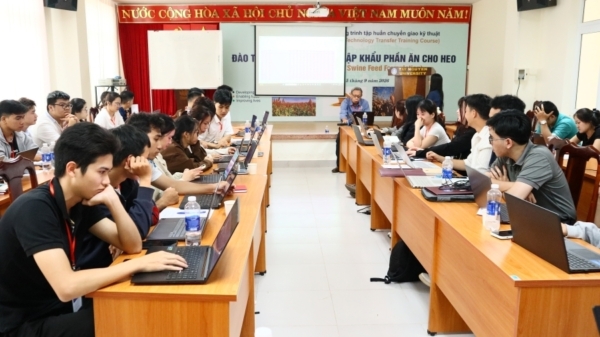
The U.S. Grains & BioProducts Council (USGBC) held its second livestock feed training program at Tay Nguyen University in Dak Lak, Vietnam, last week for third- and final-year students preparing to enter the country’s livestock and feed industries.
The program highlighted the nutritional and economic benefits of U.S. corn, corn co-products such as distillers dried grains with solubles (DDGS) and U.S. sorghum, a feed grain suited to Vietnam’s poultry, swine and aquaculture sectors.
The council’s delegation included Caleb Floss, USGBC deputy regional director for Southeast Asia and Oceania; Dr. Budi Tangendjaja, USGBC regional technical consultant for Southeast Asia and Oceania; and USGBC Vietnam representatives Tran Trong Nghia and Vu Ngan Giang.
The training marked the council’s second collaboration with Tay Nguyen University, following an earlier program that helped establish connections with future agricultural professionals and identify additional market development opportunities.
Vietnam’s growing middle-income economy and increasing consumer demand for protein have created opportunities for U.S. feed grains as the country expands its livestock production capacity.
The training began with an overview of the U.S. feed grain logistics system and DDGS production, followed by a workshop in which students used data sets to formulate feed and compare ingredient prices.
Subsequent sessions covered ingredient quality and its effects on feed formulations, species-specific nutritional requirements and the process of moving from initial formulations to production.
Graduates and faculty members expressed interest in additional advanced training to expand their knowledge of U.S. corn, DDGS and sorghum and share that information with future students. The council said the program is intended to develop local expertise and increase awareness of U.S. feed ingredients among Vietnam’s next generation of livestock and feed professionals.
Following the training, the USGBC delegation visited feed manufacturers and livestock producers in Binh Dinh, Gia Lai Province, to assess current business conditions, the commercial use and market potential of U.S. coarse grains and co-products, and opportunities for future technical collaboration.
The visits also provided an opportunity to strengthen relationships with feed industry customers and increase their familiarity with U.S. corn, corn co-products and sorghum.
According to Floss, technical training for future livestock industry professionals helps establish long-term trade relationships and positions the council as a resource for potential customers. He said meetings with feed manufacturers and livestock producers also helped identify opportunities to improve their operations while generating additional demand for U.S. grain producers.
Source: U.S. Grains & BioProducts Council, "Council Holds Training Course For Vietnamese Agriculture Sector Students"