
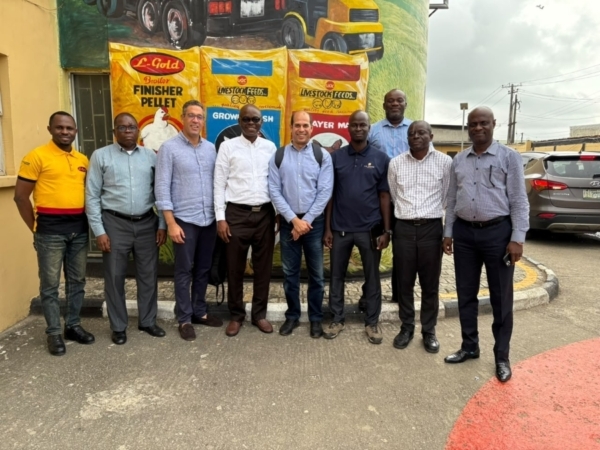
Photo credit: U.S. Grains & BioProducts Council.
The U.S. Grains & BioProducts Council (USGBC) recently sent staff from its regional office for Europe, the Middle East and Africa to Nigeria to meet with agribusinesses and discuss trade opportunities for U.S. corn, sorghum and co-products, including corn gluten meal (CGM) and new-generation distillers dried grains with solubles (DDGS).
The mission included site visits, individualized technical training and meetings with major feed manufacturers and potential end users.
Nigeria’s commercial feed industry is entering a period of expansion, with an estimated 1 million to 1.5 million metric tons of additional feed production expected in the medium term. The growth could create additional demand for feed ingredients and opportunities for U.S. corn and co-products in Nigeria’s poultry and aquaculture sectors.
Using formulation software and locally available ingredient prices, Council experts demonstrated the nutritional and potential economic value of U.S. corn co-products while addressing the specific needs of individual feed operations.
A key component of the mission was a series of customized technical sessions with feed manufacturers. Council experts worked directly with feed formulators and production teams to demonstrate least-cost formulation and evaluate opportunities to incorporate U.S. DDGS and CGM into poultry and aquaculture diets.
The Council also advanced efforts to develop demand for U.S. sorghum. Preparations continued for a poultry feeding trial planned for 2027 that will compare U.S. sorghum with local sorghum and evaluate its performance under Nigerian production conditions. The trial is expected to generate local technical data that can support future commercial adoption of U.S. sorghum in feed formulations.
Discussions with Nigeria’s food and beverage sector also assessed the technical suitability of U.S. sorghum for brewing applications. The effort could help diversify demand by developing opportunities for U.S. sorghum beyond animal feed.
The Council plans to continue providing technical support and training to Nigeria’s feed industry while connecting potential Nigerian buyers with U.S. suppliers. Through technical education, product demonstrations, local trials and trade development, USGBC is working to increase utilization of U.S. feed grains and co-products in one of West Africa’s expanding feed markets.
The meetings also helped strengthen the Council’s relationships with Nigeria’s domestic feed industry and could support connections with a wider range of customers and U.S. suppliers in the future.
Source: U.S. Grains & BioProducts Council, "Council Provides Technical Support To Nigerian Feed Millers"