
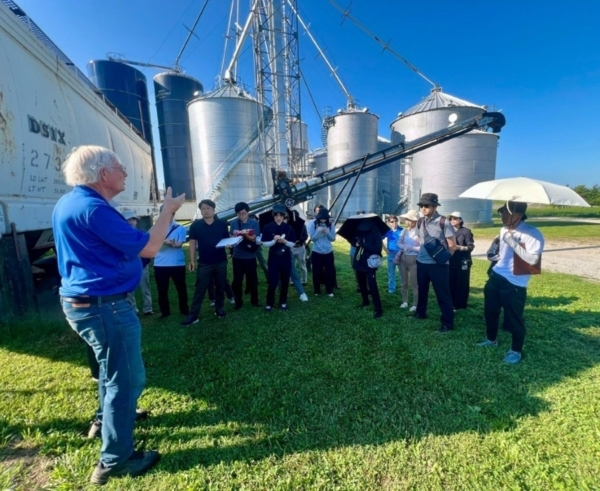
Photo credit: U.S. Grains & BioProducts Council.
Two Japanese delegations recently traveled to the United States to gain a better understanding of the safety protocols, quality assurance measures and regulatory oversight supporting U.S. corn exports to Japan.
The U.S. Grains & BioProducts Council (USGBC), in cooperation with the U.S. Embassy in Tokyo, organized the visits for Japanese government advisers and regulators responsible for feed, food and environmental regulations. The delegations met with government officials, biotechnology seed companies, industry organizations, U.S. corn farmers and companies involved in the production, distribution and export of U.S. corn.
The first delegation, led by USGBC Director in Japan Tommy Hamamoto, began its visit in Illinois with a tour of BASF's Midwest Research Farm. Participants learned about U.S. biotechnology regulations, toured breeding fields and examined the company's use of technologies such as drone pesticide applications.
A second delegation, led by USGBC Deputy Director in Japan Chris Markey, joined the first group for visits hosted by Bayer. The groups toured a Bayer test farm in Indiana and a laboratory in Missouri, gaining insight into research and development activities and technologies used to support farmers in the United States and globally.
National Corn Growers Association Chairman Kenneth Hartman hosted the delegations at his farm, where participants learned about U.S. corn farming practices. Cargill then hosted the groups at its grain elevator in East St. Louis, Illinois, providing an opportunity to examine the grain export system from farm to vessel.
After Hamamoto's delegation returned to Japan, Markey's group traveled to Washington, D.C. There, officials from the U.S. Department of Agriculture, Food and Drug Administration and Environmental Protection Agency outlined the agencies' oversight protocols related to food safety during production and export.
The delegation also participated in a roundtable with CropLife, the American Seed Trade Association and other U.S. agribusinesses. The discussion provided insight into the priorities of U.S. corn and biotechnology stakeholders and their efforts to meet the needs of international customers.
The visits were intended to help Japanese officials better understand how biotechnology regulations and approvals intersect with U.S. corn production, distribution and export systems.
Japan is a longstanding market for U.S. agricultural products, and USGBC plans to continue monitoring the regulatory and market considerations affecting corn imports. The council said maintaining access to industry experts and production and processing facilities is important to supporting the relationship and the continued role of U.S. corn as a supply source for Japan's feed, food and bioenergy sectors.
Source: U.S. Grains & BioProducts Council, "Japanese Regulatory Teams Learn About U.S. Corn Production Standards"