
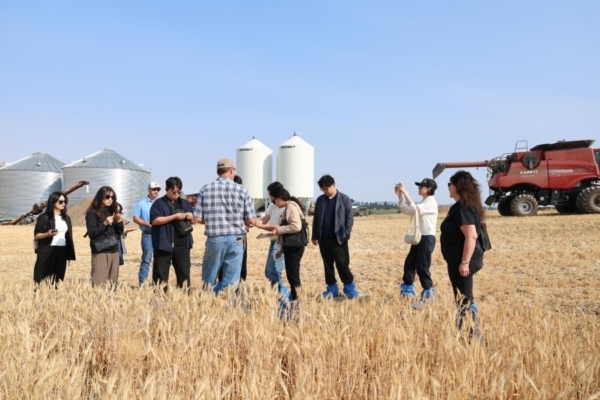
Photo credit: U.S. Grains & BioProducts Council.
The U.S. Grains & BioProducts Council recently led a delegation of South Korean food barley buyers on a tour of North Dakota, Idaho and Washington to build relationships with U.S. barley growers, processors and exporters.
The trade mission comes as tariff-rate quota provisions for U.S. barley under the Korea-U.S. Free Trade Agreement are set to expire at the start of 2027. Following the expiration, U.S. barley will be eligible to enter South Korea duty-free without government quota allocation procedures, potentially creating additional opportunities for Korean importers to purchase U.S. barley.
USGBC is using the transition to provide Korean buyers with information about U.S. food barley quality, reliability and competitiveness, as well as sourcing, purchasing procedures, contracting and supplier relationships.
South Korea consumes about 180,000 metric tons, or 8.3 million bushels, of barley annually, primarily for food processing and as a rice substitute. Domestic production varies significantly because of weather and disease concerns and typically meets only part of the country's demand, making South Korea a consistent barley importer.
The delegation began its program in Fargo, North Dakota, with presentations on U.S. barley production from Steven Edwardson and Greg Kessel of the North Dakota Barley Council. The group also toured Valley Grain Milling to learn about its barley processing capabilities.
In Idaho, the delegation met with barley supply chain stakeholders under the guidance of the Idaho Barley Commission. The group visited Josh Jones Farms and Clearwater Farms to observe barley harvesting and toured McKay Seed Company to learn about barley varieties and purchasing.
The delegation also visited the Lewiston Inland Seaport and a grain handling facility to examine safety and quality practices within the U.S. grain export chain.
Meetings with the Idaho Barley Commission, Inland Empire Milling and United Grain Corporation further expanded connections between the Korean buyers and U.S. barley industry participants.
USGBC said trade servicing, buyer education and market development efforts are intended to increase awareness of U.S. barley and support long-term export growth to South Korea. The council sees opportunities for U.S. barley both as a rice extender and as a raw material for processed barley products.
Source: U.S. Grains & BioProducts Council, "South Korean Trade Team Visits U.S. Barley Value Chain"