
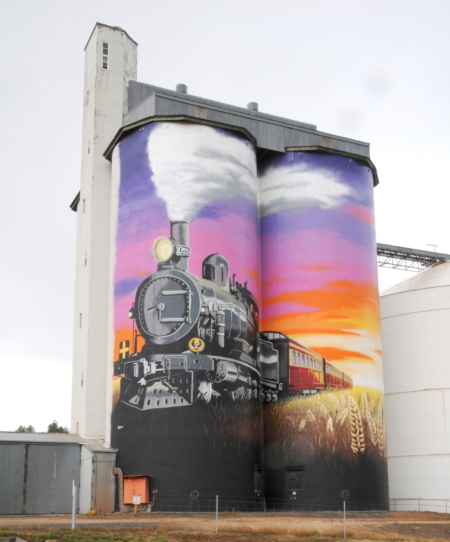
Fourteenth century Moroccan explorer, Ibn Battuta, wrote, “Traveling – it leaves you speechless, then turns you into a storyteller.”
In March 2015, FORM, an independent Western Australia non-profit, funded a massive outdoor art project on the Cooperative Bulk Handling (CBH Group) grain silos at Northam, Western Australia. This cultural art organization, which is funded by generous partners, foundations, philanthropists, and corporate sponsors, hired UK street artist Phlegm and U.S. artist HENSE.
On four of the silos, Phlegm painted his signature whimsical design based on the community’s history in ballooning; HENSE painted vibrant abstract patterns on the other four. FORM funded murals on CBH Group silos in six Western Australia communities. These murals were the seeds for what would become Australia’s ultimate road trip for adventuring tourists - the Australia Silo Art Trail.
Nine months after the Northam silo art was completed, sepia-tone murals painted by Australian artist Guido Van Helten appeared on four GrainCorp silos at Brim, Victoria. By 2017, New South Wales, Queensland, South Australia, Victoria, and Western Australia all had silos with murals. By December 2025, there were 67 silos with completed murals, and more were already funded and underway.
Support for the Arts
Where does the financial support come from for such massive undertakings? Victoria, for example, has the Tiny Towns Fund that supports projects in small communities, Regional Development Victoria (RDV) that provides grants for regional projects, shire councils that seek funding and partner with government and communities for various projects, businesses like GrainCorp that support projects in the areas where they operate, and Visit Victoria, which is involved with boosting tourism along the trail.
Sometimes the government investment is significant, as it has been in Rainbow (AUD$2.1 million dollars from the Hindmarsh Shire Council and Victoria Government), where towers and platforms are under construction that will make accessible the murals to be painted on the inside and outside of the silos. Victoria’s “Pick My Project” grant is a specific one-time grant initiative as awarded to Colbinabbin for its murals. Each state has similar funding possibilities. Federal funding is rare but possible indirectly by its support of regional arts through entities like the Foundation for Rural & Regional Renewal and the Regional Events & Innovation Fund.
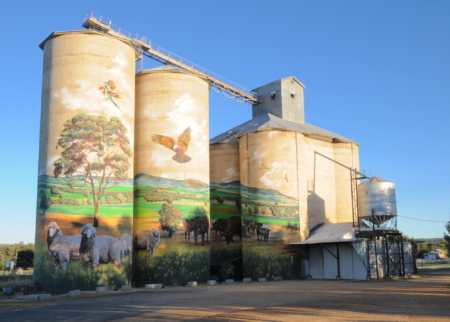
Where do the ideas originate? The subject is usually community-based and often chosen by a committee of local people who rely on old-timers, historic records, and photographs to guide them. Themes like agriculture, railroads, community history, and area flora and fauna are common. With local approval, the chosen artist interprets the ideas presented to him or her in his or her signature style, and painting begins.
Some of the artists have painted murals at several locations: Sam Bates “Smug” has painted nine, Jimmy Dvate seven, Heesco Khosnaran six, Tim Bowtell five, The Zookeeper and Drapl three, and Guido van Helten three. Many of the silos are still functioning grain operations, like the facilities at Grenfell, Thallon, and Devenish. Some are privately owned, like those at Goorambat and Gunnedah.
Surprisingly, considering the size of each “canvas,” the murals are completed relatively quickly using spray cans, rollers, and brushes. For example, The Zookeeper & Drapl painted “The Watering Hole" on the GrainCorp silos at Thallon in three weeks, Jarrod Soden and Matthew Knights of Peplswet Designs painted the Viterra silos at Farrell Flat in two weeks, and Sam Bates “Smug” painted the Warrabara Viterra silos in three weeks. The amount of paint required is determined by the size of the project. The Tungamah mural required 60 liters of paint and 142 spray cans, while the Thallon mural required 500 liters of paint and 500 spray cans. Northam in Western Australia required a whopping 740 liters of paint!
Australia’s Silo Art Trail has been an economic boom for local communities and businesses. On our fall Australia adventure, we visited 25 silo art locations. We were not alone, as tourists stood in the parking and viewing areas at each one. Some were reading the various information panels; others were taking pictures. All of us were quiet as we appreciated the massive artwork we were viewing. Now, we are the storytellers.
For more about Australia’s Silo Art Trail, visit its website australiansiloarttrail.com.
Barb and Bruce Selyem are directors of the Country Grain Elevator Historical Society. Contact the society at 406-581-1076; email: bselyem@cgehs.org.