
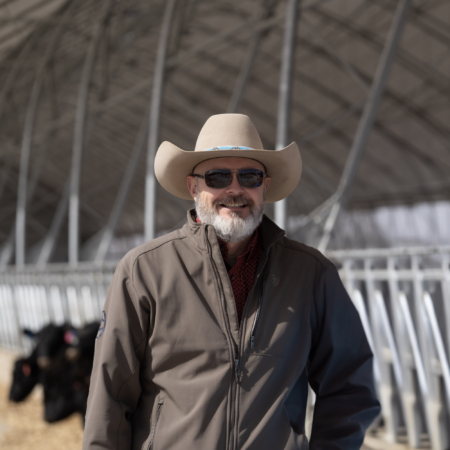
Sam Paul, editorial director at GEAPS Media Group and host of the new SGMP Podcast, recently spoke with Jason Owen, owner, and founder of Accu-Steel, about the company’s 25th anniversary, a milestone that reflects both its longevity and Jason’s commitment to doing business in rural United States. The following Q&A has been adapted from that conversation for length and clarity. Some responses have been shortened or lightly edited. Visit www.grainjournal.com/podcast to listen to the podcast.
Grain Journal: What first gave you the idea to start Accu-Steel?
Jason Owen: Accu-Steel got its start from contract manufacturing. I was at Iowa State University in the agricultural engineering department, and I was working nights at a welding fabrication shop in Ames that built a lot of grain handling equipment. I was focused a little bit too much on work and not enough on school.
I had an opportunity to get my own contract manufacturing to build portable concrete plants. I left school and went back to my farm in rural Ottoman County, outside of Templeton, IA and started building big rock boxes for a company out of Nebraska. That went on for about six or seven years, and then we transitioned over to fabric buildings. I thought there was a lot we could add to that industry.
Twenty-five years later, we have become a real industry leader. We brought some technologies and some things I saw in other industries to the grain industry that now have become very standard. Looking back over 25 years – and I don’t do a lot of time looking back – we’ve added a lot to this industry with some of the things that we’ve innovated, and it has been an interesting arc, to say the least.
GJ: What were some of the biggest challenges the business faced when getting off the ground?
JO: When I first came back to rural Audubon County, we really did not have a lot of economic development in our area for many, many years. Rural Audubon, western Iowa, gave us a lot of support, and things have changed, but at the time, the farming community had lots of great people working in it, and they knew that the writing was on the wall: They had to expand or they weren’t going to be able to update equipment.
There were a bunch of guys who I ended up being able to tap into. They were in their 40s and 50s, had their equipment paid for, weren’t renting a lot of ground, had their ground kind of under control, but they knew they couldn’t necessarily expand – or didn’t necessarily want to take the risk – but they also were kind of partially employed at the time.
So, we could tap into a wonderful workforce at the time, and we still have a wonderful workforce in western Iowa, where we manufacture the products on my farm. We gave good jobs with good benefits, and we also got a highly skilled workforce that does an excellent job manufacturing for us.
GJ: Were there pivotal decisions or any risks that helped you shape the company’s direction?
JO: I think it’s the no’s that make a difference in starting a business – where people say no and where people know their limits. I’m happy to have a little bit of luck on my side. And we made lots of mistakes. When we made mistakes, we just worked harder, you know, and that’s something that at that time, I was still on the floor working and welding the products.
I’m very fortunate to have some of the skills it takes to actually build products and weld and cut and do a little bit of design, and then I also have a little bit of the experience to be on the office side of it and make the sales and manage the business.
If we didn’t understand exactly what we were doing, we knew we could work hard. We knew we understood the basics of business, and some of the things that we didn’t know, we just let happen. Sometimes it was an expensive lesson. Sometimes it was a very cost-effective lesson. It was a lot of trial by fire and a lot of hard work, but we were able to stay on that narrow path and create a successful business.
GJ: Has your view of entrepreneurship changed over the years since you started?
JO: I don’t know if you can go to school to learn about how to be an entrepreneur. Entrepreneurs have an unhealthy and unbalanced amount of risk tolerance, and you really can’t teach that. I think some of that risk came from my growing up on the farm and watching my parents take on weather risk, farming risk, and being able to go to bed at night knowing that there’s risk.
That is the profile of someone who wants to start their own business – it doesn’t matter what it is or whatever industry you want to work in. I think being able to step out on your own and say, “I’m responsible for myself. I’m responsible for my own payroll, my own health care, and my own paycheck.”
Being able to manage all those different aspects and continue to function and get that product out the door or provide the service that you’re obligated to is something that you have or you don’t. The entrepreneur just does it. He or she just goes out and makes it happen.
GJ: What do you think makes running a business in a rural community unique?
JO: It’s rooted in being a little flexible with some of the employees who are still involved in agriculture. We have a very farmer-friendly type of culture in our company. Some people can work in the summers and the winters but need a little time off in the spring or fall, and they’ll make up their hours. We try to be very flexible with that. There are still a lot of untapped opportunities in rural America, especially in Iowa.
GJ: How do you approach attracting people to the area and keeping good employees?
JO: Paying a fair wage is a part of it, but I think also creating a culture where people feel like they have an opportunity to advance – a way for them to develop a career and still have a good work-life balance.
Being in western Iowa, I can’t speak for all other parts of the state, but we’re in a very low-populated area. Ottoman County has around 5,000 people, so it is hard to attract talent.
I’m speaking to you from Des Moines, IA, because we’ve opened an office here to get some of that front-end business talent to come. It takes a little bit of a gameplan to provide the manufacturing side of the business but also the front-end side of the business.
GJ: As Accu-Steel celebrates 25 years, what are some important lessons that you’ve learned along the way?
JO: At the end of the day, what has allowed Accu-Steel to be successful is that we have built very high-quality components, we make a very quality product at a very fair price, and we’ve stayed focused on the customer. We want to add more value and more efficiency to their operation than what they were doing before they met us. We must make products that work for the customer and stay customer focused.
GJ: What are some of the biggest changes and challenges your customers are facing today?
JO: As I speak with you on our 25th anniversary, grain prices are similar to what they were when I got started. At the farming level, we’re really challenged with some tough commodity prices. I think we’ve seen a lot of vertical integration, coop consolidations, and pressure for efficiency in agriculture that we didn’t have 20 or 25 years ago.
Technology has really changed the game. Everything is done automatically – the technology, the seed, the chemicals, the fertilizer, the prescriptive – getting the best return out of every acre. The equipment’s changed. Efficiency has become the biggest keyword.
Being able to adapt to the current environment is what makes agriculture so great. We continue to have record crops. We continue to feed the world regardless of what that individual economic outcome is; we still produce. We are still the breadbasket for the world.
GJ: What does the next chapter look like for Accu-Steel and for you personally, as a business owner?
JO: I’m starting to get into this phase of business ownership where other key employees and partners start to build their own arcs in the business, under the umbrella of Accu-Steel, and put their own mark on what Accu-Steel means and can do for customers.
I’ve been really interested in seeing that transition start to take place where I’m not as actively involved in the business as I was at one time. I’m still more on the front end of the business but not so much on the back-end manufacturing.
Seeing other people step up and being able to give them the space to do that gives them the ability to manage their departments – people with that entrepreneurial spirit who are tougher than everybody else in the industry and good at getting things to a certain spot.
I’ve had to give up some of those reins and let people have their own direction and just make it easier and make the process smoother for the business to continue to grow.
GJ: If someone came to you today wanting to start their own business in a small town or a rural community, what advice would you give them?
JO: It depends a little bit on the business. If you’re passionate about it, if you feel like that’s your calling – to be able to give back to the community through service using your God-given abilities – I don’t think there’s any reason not to go after that right away.
You have to make sure you have a good plan. I had good mentorship back in the day. I had some very key people in my business arc who took me under their wings and exposed me to things that I had really no business being exposed to at that age.
I don’t have a diploma hanging on the wall, but I’ve had a lot of education in the school of hard knocks. If somebody has a passion about what they want to do, they feel like it’s a solid business model that makes sense on paper, it’s got cash flow opportunity, it’s got returns, it’s something that’s worth investing their time and talent into, I encourage them to do it.
At the end of the day, it doesn’t really matter how much money you make, but you have got to make money. That’s how we keep track of things. It’s got to be a positive business from a cash-flow standpoint and able to pay the bills.
GJ: After all these years, what keeps you excited about your work?
JO: I think one of the most rewarding things for me personally is still seeing a young family that is coming back to their family’s farm operation, and they maybe can’t pick up enough ground to really justify it, but we’re able to provide a cattle building so that young family wants to come back and raise their family on the farm. We can take a very small piece of land and provide an opportunity for them to have a positive income with some of our building products.
To me, that is one of the most rewarding stories. We want to help get that next generation back to the farm in a cost-effective, profitable way, where there’s a business model that allows people to be with their families on the farm, ready to take over when the time is right.
The other part of that is you see someone working for you, and they’re driving a little tough car. Pretty soon, you see them get a little bit better vehicle. And then maybe you hear that they want to buy a better house.
You see people’s quality of life change through the business, and you see their involvement in being part of that family and growth in the company. That’s been rewarding – to see peoples’ personal growth through something that I’ve been able to start and maintain, along with the people who filled in a lot of the pieces of this business as it’s grown.