
While the temptation is great to relax about grain quality once the product is in winter storage, managers should continue monitoring and managing conditions to optimize grain quality, safety conditions, and profits.
The often repeated saying “grain never improves during storage” is never more accurate than during the winter. However, the cooler temperatures and lower relative humidity of the season can be leveraged by managers to help maintain quality.
Failure to manage stored grain during winter can allow mold, insects (yes, even in winter), and poor-quality pockets to form. Small problems develop into big, costly, hazardous ones.
The first step to prevent small problems is consistent monitoring at least every two weeks. Monitoring can include several methods, and each of these methods can be considered “communication” with the grain.
Forms of Communication
1. Visual inspection. Check the surface of the grain mass to assess conditions in the headspace. Look for changes in surface color that indicate crusting and mold from moisture collecting under the roof and in the headspace.
In areas prone to Indian meal moth infestation, webbing may form on this top surface. Off odors in the headspace may be detected during this visual inspection of the top surface. Coring the bin to remove fine material can help aeration efficiency and make visual inspection easier.
2. Grain temperature cables. Hot spots indicate some kind of biological activity. There is no question that these hot spots are undesirable and should be quickly resolved.
Hot spots are caused by high moisture content as a result of insect activity or mold development. Sometimes these spots are a result of a load of high-moisture grain not being distributed throughout the bin or a warmer load of grain being placed on top of cooler grain.
If the aeration system doesn’t operate long enough to establish a consistent temperature throughout the bin, a layer of mold may form inside the bulk of the grain. This can cause a shelf or bridge to form. Temperature cables may detect this mold activity.
Anytime the grain temperature increases inside the grain bulk and goes above the ambient temperature or the average grain bulk temperature, there is need for concern.
Running the aeration system may lower the temperature in the area of concern temporarily, but it is not a remedy. The grain should be moved to another bin to break up the hot spot. It might also be a good time to consider selling this grain.
Long-term storage of a bin with an area that is heating can result in difficulty unloading the grain later, unsafe worker conditions due to the need to break up clumps or stuck grain during unloading and bin cleaning, and self-combustion resulting in a smoldering fire and a potential explosion.
3. Pull samples. Sample several spots throughout the grain mass to can give some indication of moisture and quality. Some bins are constructed so that samples can be pulled from below and from the top of the bin.
Many problems with insects and mold occur in the top-center and at unloading points. Research shows a strong increase in insect activity at these locations, particularly in regions of the country where the grain cannot be quickly cooled below 60 degrees F. Most insects become inactive below 60 degrees F and die or go dormant below 32 degrees F. While sampling gives limited information about large areas of a bin, it can help diagnose some of the high-risk areas.
4. Monitoring carbon dioxide. Carbon dioxide (CO2) is produced from biological activity; thus, it is a good early warning to managers. Establish a baseline CO2 level at binning, then monitor the CO2 levels at fan exhaust or headspace power vents every week. The highest CO2 reading can be compared to the baseline reading. Increases, particularly an increasing trend over several weeks, indicate a developing problem in the bin due to either insects or mold. Managers should consider moving the grain in the bin to another bin or marketing the grain.
CO2 monitors are relatively inexpensive when compared to the value of the grain in the bin and provide good early information about activity in the bin.
5. Odor detection. By the time an employee detects off odors outside the bin, at the fan exhaust, or in the headspace, the grain quality has been severely diminshed. During the winter when aeration may not be used as often, odors tend to not be detected as easily. Running aeration fans periodically can help move these odors out of the grain. However, if subsequent aeration continues to produce detectable odors, deteriorating grain can be assumed. Moving the grain to break up problem areas is important before temperature rises and spreads in the problem areas.
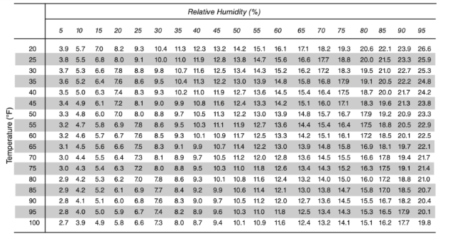
6. Aeration management. Managers must be aware of the relationship between equilibrium moisture content (EMC) and the desired moisture content of the grain. A good grasp of the air temperature and relative humidity and how it might impact the desired moisture content in the bin if this air is moved through the grain via the aeration system is important. Grain quality can be reduced by running aeration fans at the wrong time. However, winter conditions often allow managers to prevent mold and insect problems when aeration is managed appropriately. The chart above is an example of an EMC chart for corn.
Grain prices and profit margins make monitoring grain during the entire storage period (including the winter) an essential part of good grain storage management.
Loss of grain quality is expensive and may even cause safety challenges for employees and deterioration of structures in the facility. Establish a manageable monitoring protocol and develop habits with employees to monitor correctly and frequently. Record observations so that trends can be detected.