
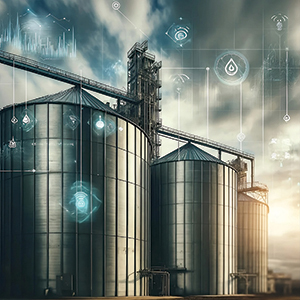

The post-harvest ag supply chain is facing unprecedented change but also unprecedented opportunity. Those who embrace adaptive, technology-driven strategies will not only survive these shifts – they’ll thrive.
The ag supply chain has always been a complex balancing act between efficiency, sustainability, and risk management. However, notable new pressures – environmental, technological, and economic – will continue to reshape the way we think about storage, transport, and quality preservation.
Climate is Rewriting the Rules of Storage and Transport
From extended droughts to record-setting floods, extreme weather is disrupting traditional grain storage and logistics. In regions like the U.S. Midwest and Australia, inconsistent rainfall patterns are forcing producers to rethink drying and aeration strategies, as temperature and moisture variations inside grain bins are becoming more erratic. Meanwhile, heat waves in South America are accelerating spoilage risks in stored soybeans, making real-time monitoring more critical than ever.
Moreover, supply chains across oceans and along waterways are facing new vulnerabilities. Recent shipping disruptions in the Red Sea and Mississippi River low water levels highlighted how climate-linked challenges aren’t just about farming; they affect how and when crops reach the global market.
The industry can no longer rely on seasonal “rules of thumb” for storage and transport. Adaptive management, powered by real-time sensing and artificial intelligence (AI)-driven predictive analytics, is becoming a necessity rather than a luxury.
AI and Automation
The integration of AI and automation is revolutionizing post-harvest grain storage management. Generative AI, the new wave of AI capable of producing new content and insights, is anticipated to enhance decision-making processes in storage and logistics.
By analyzing real-time data from Internet of Things (IoT) sensors – monitoring factors such as temperature, humidity, and carbon dioxide levels – generative AI can provide actionable recommendations to storage managers. This fusion of textbook guidelines with live data promises to deliver insightful directives, optimizing storage conditions and mitigating spoilage risks. For instance, AI-driven systems have been developed to identify common stored grain insect species with over 96% accuracy, allowing for rapid pest control measures and reduced economic losses.
Furthermore, AI-powered solutions are being integrated into grain elevators, enabling predictive maintenance, optimizing storage conditions, and enhancing grain quality management through automated management processes. These advancements not only improve operational efficiency but also safeguard grain quality throughout the storage cycle.
By leveraging AI, grain storage facilities can transition towards more autonomous operations, often referred to as “lights-out” facilities, where systems operate with minimal human intervention. This approach enhances efficiency, reduces labor costs, and minimizes human error, leading to more resilient and sustainable supply chains.
Commodity Prices and Storage Risk
Recent shifts in trade policy and macroeconomic factors are driving up prices for key agricultural commodities. Corn, soybeans, wheat and even Arabica coffee are seeing increased volatility due to tariffs and climate uncertainty.
As a result, many producers are holding stocks longer in anticipation of higher prices. However, longer storage times increase the risk of spoilage, particularly in regions with high humidity or fluctuating temperatures. Our own data from global deployments shows that over 50% of monitored grain and oilseed bins require at least one intervention per storage cycle, and that number is increasing as storage durations stretch.
Meanwhile, for exporters moving grain via ocean freight, there’s another challenge: Conditions inside cargo holds can rapidly deteriorate as ships cross multiple climate zones. Monitoring these conditions in real time is becoming a critical tool for preventing losses and reducing insurance costs.
What this means: Agribusinesses need to treat stored grain as a dynamic asset, not a static one. Holding onto stocks for longer means investing in better monitoring, smarter aeration, and AI-assisted quality management to maximize profitability while mitigating risks.
The post-harvest agriculture supply chain has always been a complex balancing act between efficiency, sustainability, and risk management. However, notable new pressures – environmental, technological, and economic – will continue to reshape the way we think about storage, transport, and quality preservation.
Sotiris Bantas, Ph.D., is CEO of Centaur Analytics, Inc. in Sacremento, CA.
For more information on the changes happening across the industry, contact Centaur at
midwest@centaur.ag, or call +1 217 418 9662.